
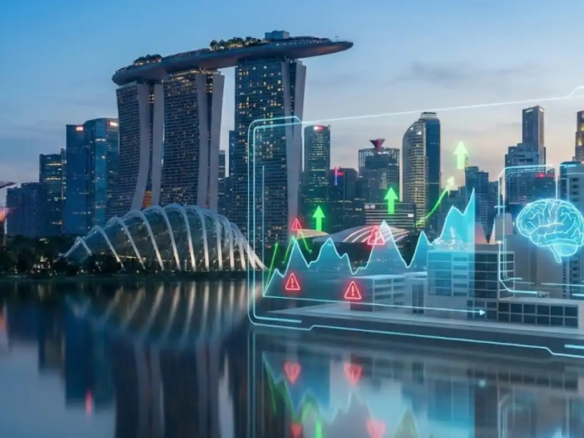
AI real estate Singapore is no longer a future concept but an active force reshaping how buildings are designed, operated, and valued. From energy optimisation to predictive maintenance, AI real estate Singapore promises efficiency gains while raising new questions about energy use, governance, and sustainability.
How AI Real Estate Singapore Is Changing Building Operations
Across Asia, AI is automating tasks once handled manually, and Singapore is moving quickly in step. Smart cooling systems now adjust in real time to occupancy patterns, lifts predict faults before breakdowns occur, and lighting systems respond dynamically to usage data.
At a recent sustainability forum in Singapore, industry leaders noted that more than one-third of real estate tasks can already be automated. In markets like South Korea, these tools have cut operating costs by up to 20 percent and boosted rental income. AI real estate Singapore is now applying similar models across commercial districts and mixed-use developments.
Digital Twins and District-Level Intelligence
One defining feature of AI real estate Singapore is the use of digital twins. These virtual replicas simulate building performance, traffic flow, flood risks, and even shadow patterns before construction begins.
Singapore’s long-running Virtual Singapore initiative has laid the groundwork for this approach. At the district level, projects such as Punggol Digital District link energy, mobility, and building systems through a shared digital platform. The goal is coordinated planning rather than isolated building-by-building optimisation.
Developments in one-north are also embedding AI-enabled systems to manage cooling, air quality, and occupancy. These sites illustrate how AI real estate Singapore is shifting from isolated smart buildings to connected urban ecosystems.
The Sustainability Paradox of AI Real Estate Singapore
Despite its efficiency promise, AI real estate Singapore faces a fundamental contradiction. Buildings already account for more than 20 percent of national emissions, and air-conditioning alone consumes roughly half of a commercial building’s electricity.
AI systems themselves require heavy computing power. Large models rely on energy-intensive data centres, increasing electricity demand and cooling needs. Studies show data centres already consume a significant share of Singapore’s power, a figure expected to rise as AI workloads grow.
The risk is clear. Without careful planning, AI real estate Singapore could offset its own emissions savings, undermining sustainability goals under the Singapore Green Plan 2030.
Governance, Data, and Human Oversight
Another challenge for AI real estate Singapore lies in governance. Real estate data is often scattered across legacy systems, limiting AI accuracy. Poor integration can produce flawed insights that scale rapidly across automated platforms.
Bias is another concern. AI models trained on historical leasing or valuation data can replicate outdated assumptions if not continuously audited. Strong internal controls, transparent review processes, and standardised data protocols are becoming essential foundations.
Crucially, AI does not replace human judgment. Industry leaders stress that AI real estate Singapore only delivers value when professionals are trained to interpret and challenge automated recommendations.
Singapore at a Regional Crossroads
Asia Pacific is the fastest-growing market for AI-driven property technology, and Singapore sits at its center. Yet its compact size, high cooling demand, and limited energy headroom mean mistakes carry higher costs than in larger economies.
For policymakers, developers, and investors, the focus is shifting from whether to adopt AI to how responsibly it can scale. The future of AI real estate Singapore will depend not just on smarter software, but on parallel advances in energy systems, data architecture, and workforce capability.
What emerges next will shape whether AI becomes a true sustainability ally or a costly contradiction in Singapore’s built environment.